Why Architecture Must Learn to Become Unnecessary

Oznur Pinar CER, RIBA
Founder & Chief Architect

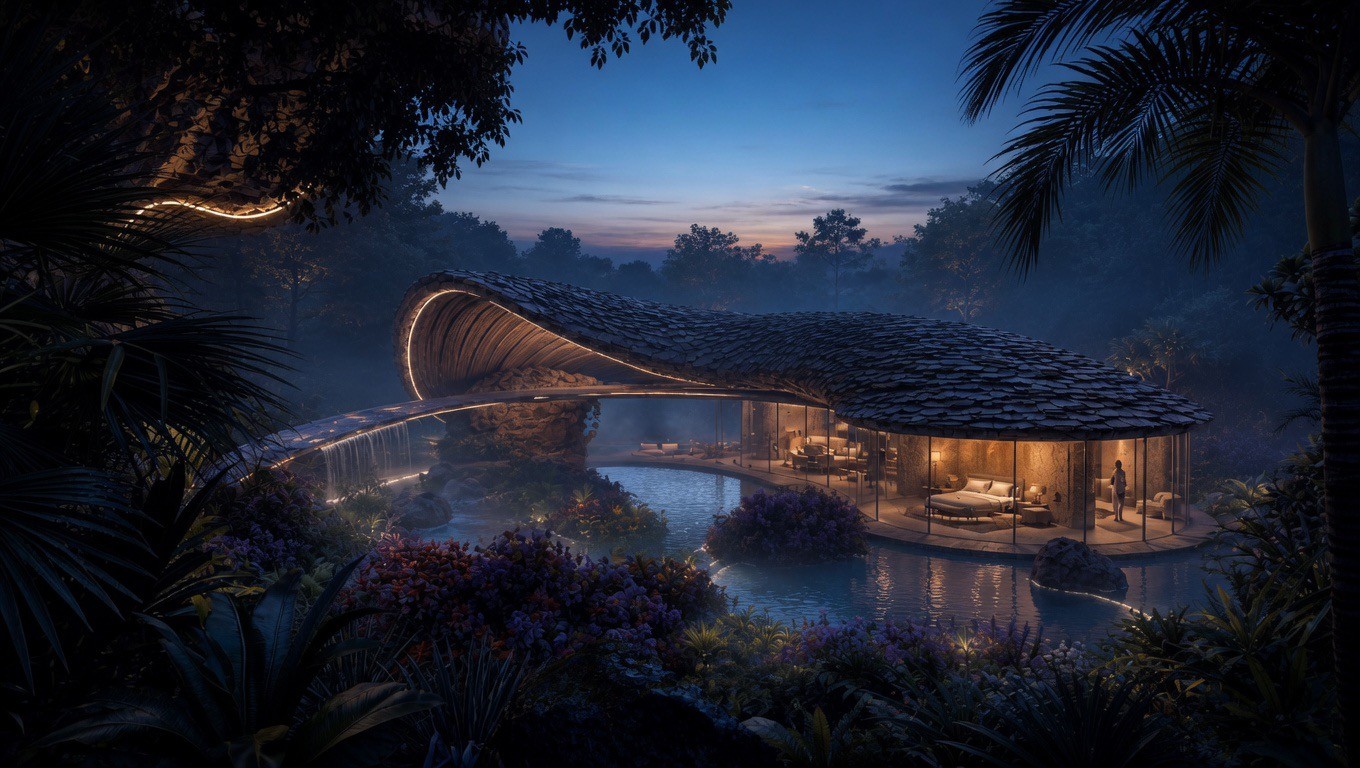
There is a question I return to constantly in my practice — one that most architects are trained never to ask:
What right does a building have to exist?
Not in a legal sense. Not in a planning sense. But in an ethical, almost philosophical sense. What gives us — as architects, as designers, as inventors — the authority to place a permanent object on a site that already holds its own intelligence, its own ecology, its own memory?
This question became the foundation of LAYER ZERO, our retreat villa in Japan. And it changed everything about how I think about architecture.
The Arrogance of Permanence
We are taught, from the first day of architecture school, to build for permanence. To design structures that endure. To leave a mark. The great buildings of history are celebrated precisely because they survived — the Pantheon, the Hagia Sophia, the Fallingwater. Permanence is equated with quality. With mastery. With legacy.
But I began to ask: what if permanence is simply arrogance dressed in concrete?
Every site we build on already exists. It has its own logic — its rock formations, its water flows, its seasonal rhythms, its biological networks. When we place a building on that site, we are making a declaration: our vision supersedes yours. We are saying that what we bring is more valuable than what was already there.
Sometimes, that is true. A hospital. A school. A home for a family. These justify their presence through use, through human need, through the lives they enable.
But a luxury retreat villa in the forests of Japan? A private sanctuary in a landscape of exceptional ecological density? What justifies that?
Layer Zero as Protocol
In Japanese spatial philosophy, ma describes the meaningful void — the generative emptiness between things. It is not absence. It is potential. It is the pause between notes that makes music possible.
LAYER ZERO began with ma. Before we designed anything, we spent weeks studying what was already there — every rock formation, every still water pool, every seasonal lake, every path that water took through the terrain after rain. We called this inventory Layer Zero. The foundational stratum that exists before any human intervention.
And we made a commitment: Layer Zero would remain the primary protagonist. The architecture would be a lens, not a barrier. A frame, not a statement.
The building we designed does not occupy the terrain. It inhabits the terrain's own absences — the negative spaces between stones, between water and land, between forest and open sky.
Designing to Disappear
Then we went further.
We asked: what if the building could gradually return what it borrowed?
The primary structure is formed from rough-textured shotcrete — not because it is cheap or easy, but because its intentionally porous surface creates micro-voids that retain moisture and trap windborne spores. There are no curated plantings. No maintenance regime. The architecture simply waits. And nature arrives on its own schedule.
Over ten years, moss and lichen colonise the structure. Edges soften. The Shou Sugi Ban timber silvers toward the colour of the shell. The dry-stack stone walls — assembled without mortar — blur into the surrounding terrain. The roofline merges with the forest canopy.
By year ten, there is no building. There is an ecosystem.
This is not deterioration. This is the highest form of architectural intention I know: to design something so precisely calibrated to its context that, given enough time, it becomes indistinguishable from what was always there.
What This Means for Architecture
I am not arguing that all buildings should disappear. I am arguing that every building should earn its permanence.
At MASK, we have always believed that our role is not to impose form on the world, but to invent the systems, technologies, and philosophies that allow architecture to give back more than it takes. The atmospheric water harvesting technology we developed for Baobab Resort. The kinetic solar systems of Fiji Solar Crown. The hydrological cycle of Layer Zero.
These are not features. They are ethical positions.
The most radical thing an architect can do today is not to build more boldly. It is to question whether the building needs to exist at all — and if it does, to ensure that the world is demonstrably better for its presence.
Architecture that becomes unnecessary is not a failure.
It is the highest ambition.
Öznur Pınar Cer is the founder and chief architect of MASK Architects, based in Olbia, Sardinia. She is also a founding partner of AQH Italy.
© MASK Architects 2026 — All Rights Reserved
Subscribe to Our Newsletter
Share